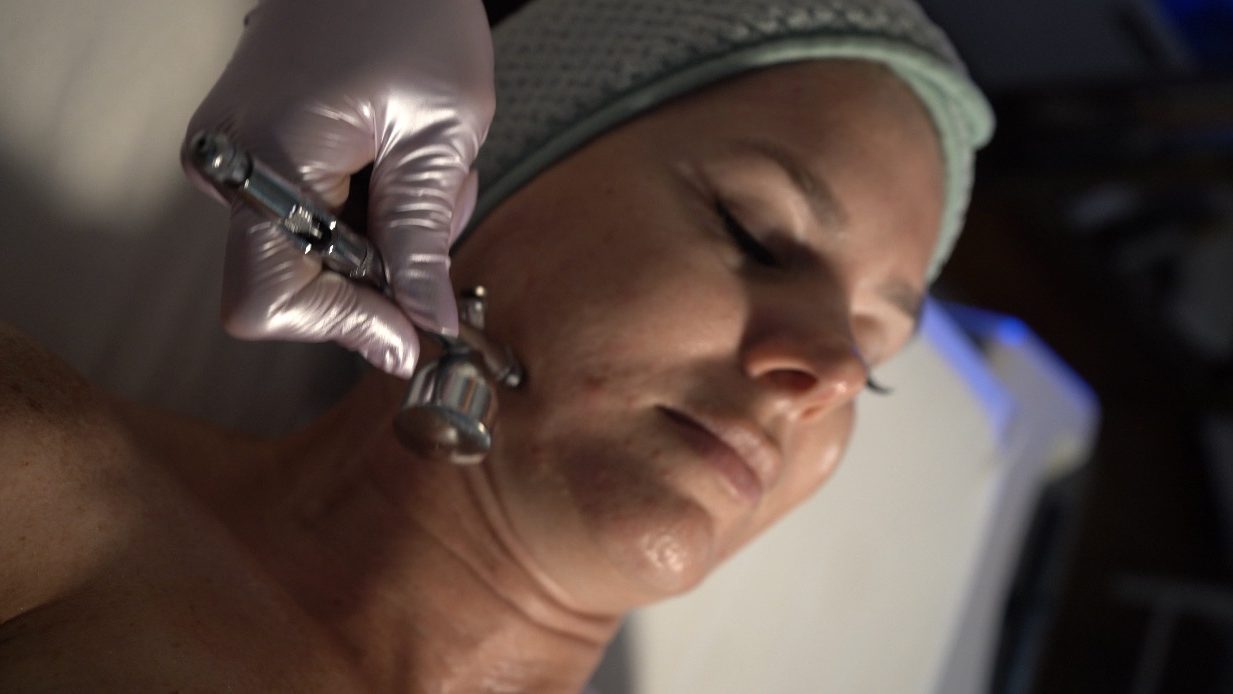
Oil Dermaplaning: Why I Never Do It Dry
A client told me recently that she had given up on dermaplaning. Her skin had felt tight and raw for two days afterward, and she assumed that meant her skin was too sensitive for it. Her skin was fine. The method was wrong for her.
Dermaplaning is having a long moment, and most of what is written about it describes one version of the treatment: a blade drawn across completely bare, dry skin. That is how it is taught, how it is demonstrated, and how the overwhelming majority of it is performed.
I do not work that way, and I have not for years. Every dermaplaning treatment I perform is done over a layer of facial oil. It is a small change in method and a large change in outcome, and it is the reason people who were told their skin could not handle dermaplaning are having it here without trouble.
The problem with dry
Dry dermaplaning works. I want to be fair to it, because it is a legitimate technique and there are situations where the more aggressive exfoliation it produces is exactly what skin needs.
But the mechanism that makes it effective is also its weakness. A blade moving across bare skin creates friction on every single stroke. That friction is doing part of the exfoliating work, which is useful, and it is also creating heat and micro-trauma across the surface, which is less useful.
On resilient skin, that is a fair trade. On skin that is dry, reactive, thin, rosacea-prone, or simply older and more fragile, the friction is the whole problem. It is why some people leave a dermaplaning appointment with skin that feels tight, looks flushed, and stings when they apply anything that evening. Those people are usually told they are too sensitive for the treatment. Most of them are not.
What the oil changes
When there is a layer of oil between the blade and the skin, the blade glides. It still lifts dead cells and vellus hair, because the angle and the pressure are doing that work, but it stops dragging across the surface to get there.
Comfort changes immediately. The scraping sensation people brace for mostly disappears. This is the treatment clients fall asleep during.
Irritation drops sharply. Less friction means less heat, less redness, and far less chance of the micro-abrasion that leaves skin feeling stripped.
The barrier stays intact. This is the part that matters most and the part nobody talks about. Dry dermaplaning removes your surface layer and gives nothing back, so skin can feel tight for a day or two afterward. With oil, the skin is being conditioned throughout the treatment rather than repaired after it. You leave soft rather than bare.
And it opens the treatment up. Skin that genuinely could not tolerate dry dermaplaning can usually have this comfortably. That includes dry and dehydrated skin, mature skin, reactive skin, and skin in the middle of hormonal change.
The friction was never the point. It was just how everyone learned to do it.
What it does not change
Oil dermaplaning is still exfoliation, and I would rather be straight with you about the limits than oversell the method.
Your skin is still more vulnerable to sun afterward, so daily SPF is not optional. Acids, retinol, and scrubs still wait three days. The results still last roughly three to four weeks, because that is how long the surface takes to rebuild.
It also does not change the thing everyone worries about. Hair does not grow back thicker or darker after either version, because cutting a hair cannot change the follicle that produced it. Vellus follicles keep producing vellus hair. I have written out the full explanation on the dermaplaning page if you want the detail.
And there is one honest trade-off. Dry dermaplaning does produce a more aggressive surface exfoliation. If maximum resurfacing is your actual goal, I would not push you toward a more aggressive dermaplane at all. I would put you in a peel, which is the right tool for that job.
Side by side
Ask for it by name
If you have had dermaplaning before and did not enjoy it, or you were told your skin was too sensitive, it is worth asking whichever practitioner you see whether they work dry or with oil. Most will say dry, because that is the default.
Here it is not an upgrade or an add-on you have to request. It is simply how I do it, with my own Glow Renewal Drops as the oil, and it is included in Golden Hour HydraGlow and Tighten & Glow RF.

Twenty years in the treatment room, more than 500 non-surgical facelift treatments, and the founder of Organiglo. There is no front desk here and no rotating staff. You book with me, and I am the one in the room.
Come and feel the difference
Golden Hour HydraGlow is where I would start you. Oil dermaplaning, then deep hydration layered onto the freshly cleared surface.
Book Golden Hour HydraGlow Or read the full dermaplaning guide
Written by Melanie White